The Radically Honest Guide to Fertility Treatment
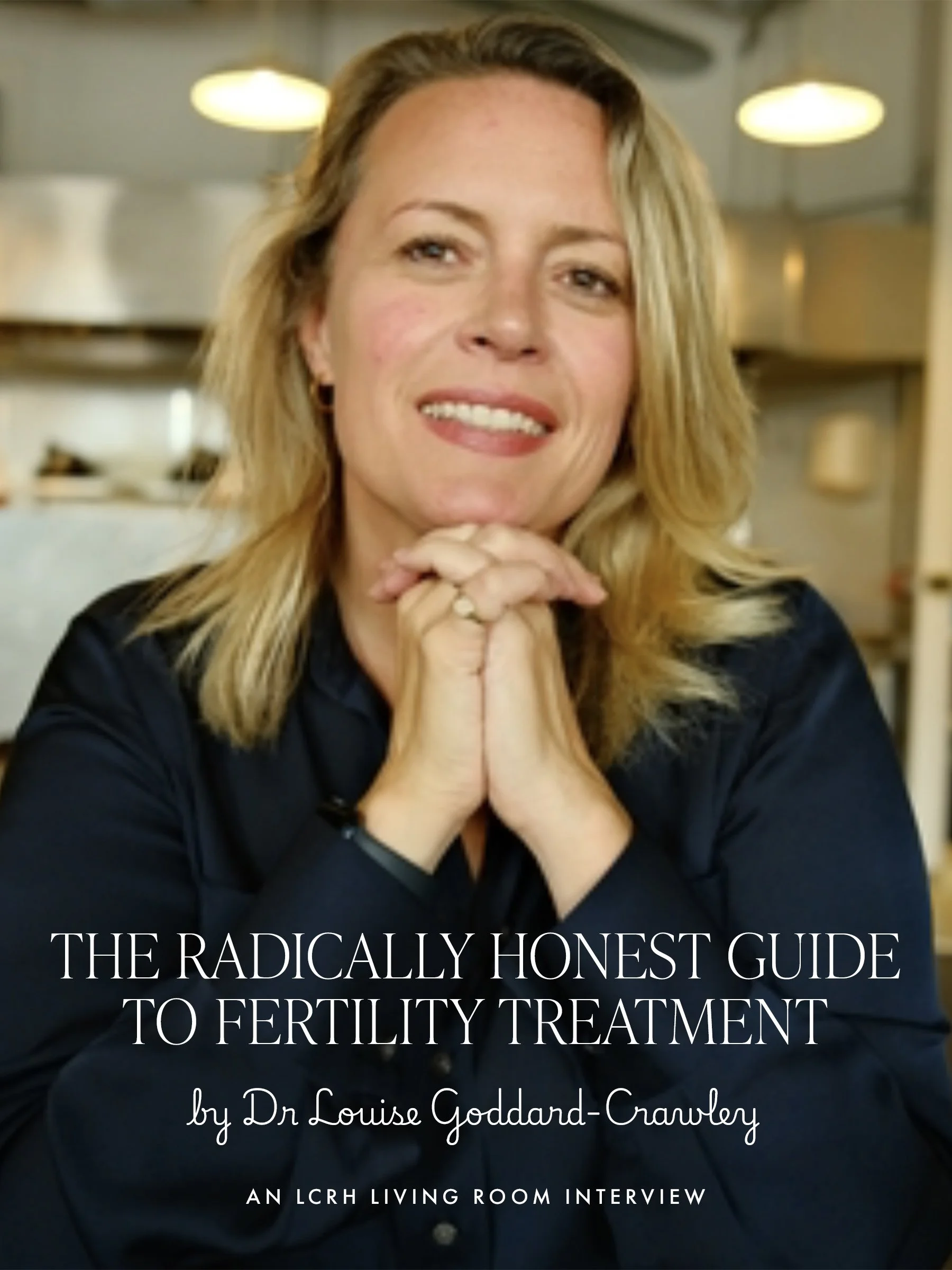
Dr Louise Goddard-Crawley
Chartered Psychologist and Associate Fellow of the British Psychological Society, Dr Louise Goddard-Crawley, has dedicated her career to the practice of fertility psychology. This month sees the release of her book: ‘The Radically Honest Guide to Fertility Treatment: How to Navigate the Process and Take Back Control’ (Bloomsbury).
Co-authored with fertility nurse Jules McDonald, The Radically Honest Guide to Fertility Treatment is an updated edition of ‘If Only I Knew’, a book Dr Chapman has often suggested to patients. The connection between Dr Louise Goddard-Crawley and LCRH also extends further, as Louise and partner Nicky welcomed daughter Mara in 2025 as patients of LCRH.
We caught up with Louise for a chat about what readers can expect in ‘The Radically Honest Guide to Fertility Treatment’, some tips on practical ways to navigate the Two Week Wait, and memories of her own fertility journey with Dr Chapman and LCRH.
LCRH: What led you, initially, to writing your book?
Louise: Over the years, first as a fertility nurse and then as a psychologist, I kept hearing the same thing: "If only someone had told me..." It was, "If only someone had told me progesterone could affect my mood," or "If only someone had told me this..." or "...that." There were so many "I wish I'd known" moments that I started writing them down.
Then I was speaking to my friend Jules, and out of the blue she said, "I've just been into a bookshop, and there are no guides to fertility whatsoever. I'd love to write one." I said, "Well... I've actually just started writing one." It turned out we were thinking exactly the same thing, and that's how the collaboration began. Jules lives in the UAE, so there was a lot of back and forth writing chapters. Jules brought the clinical fertility expertise, and I brought the psychology, so it became a really lovely partnership.
Jules and I self-published the book, and within a couple of weeks it reached the number one spot on the Amazon charts for conceiving and fertility. We had such positive feedback that Bloomsbury approached us about producing a second edition.
LCRH: Around this time you also chose to work with LCRH to build your own family…
Louise: My partner Nicky and I had reached the point where we wanted to start a family. I don't know if there's a bigger compliment I could give, but after spending the last 10 or 15 years working in fertility, I could have chosen any clinic. I chose Lynne Chapman because I genuinely believed she was the best person to help us. We had a really lovely experience with LCRH. It was easy, kind and holding. We were incredibly lucky that it worked first time for us, and now we have our 16-month-old daughter, Mara.
LCRH: What can readers expect from ‘The Radically Honest Guide to Fertility Treatment’? How does it differ from ‘If Only I Knew’?
Louise: We kept those 'Radically Honest' moments from If Only I Knew, which are the part of the book I'm most proud of because they cut through all the noise to the most important thing you need to know. The new edition is also shorter and more concise.
I would almost have a script that I'd follow with patients because I was asked the same questions so many times. It's not like I'd ever have to invent an answer - these questions kept coming up. So I'd almost say exactly the same thing every time. It really highlighted the same gaps in knowledge again and again.
Our message is: educate yourself before you start treatment so you're not on the back foot when someone says IVIG or ICSI, or starts using all the technical language. You can think, "Oh, I know what that is because I've already spent some time educating myself."
The second edition is also a little more positive and hopeful, and it now covers the whole fertility process. It starts with, "This is what your period is, this is why you ovulate, this is what your fertile window is." In women's health, we're not taught those things. We're taught, "This is how you don't get pregnant," but we're rarely taught, "This is how you do get pregnant." We wanted to change that.
LCRH: It's interesting, isn't it, when you have this experience of these questions being so similar for so many people, that there is that mystery.
Louise: I think it shows there are still some really big gaps in the information people are given. If so many people are asking the same questions, then perhaps we're not preparing them as well as we could before treatment begins.
It's time for a change in fertility care, and Lynne Chapman has always done exactly that. She took the time to draw diagrams, make sure Nicky understood, and explain everything in a way that made us feel informed and involved. It was that warmth and kindness that made such a difference.
When I first started working in fertility there was still a great deal of shame surrounding fertility problems, particularly for women. Over the last decade I've seen that begin to change, and I think that's something we should all be proud of.
LCRH: At LCRH we have something called the Two Week Waiting List, which is a series of questions with answers shared by former patients. One of the questions asks suggestions for an emotional support care package for the Two Week Wait. What would you include?
Louise: Speaking as a psychologist, I think distraction is one of the best ways to get through the two-week wait. Find a TV show, a radio show, a podcast or something that genuinely makes you laugh. When we're anxious, our attention narrows and we can become completely consumed by what's happening. Even brief moments of laughter or enjoyment can interrupt that cycle and give your mind a chance to reset.
I always joke that, if I had to prescribe anything, it would be Schitt's Creek. So many people tell me it's their go-to during treatment. If I had to design a two-week wait package, it would simply be: watch a couple of seasons of Schitt's Creek.
LCRH: A frustration for some is when those outside of their situation tell them to ‘calm down’ or ‘relax’. Does this connect to your Radical Honesties?
Louise: Quite a few of our 'Radically Honest' moments are about how to deal with people giving well-intentioned but unhelpful advice. We're also planning some social media posts about what to say to your friends and family to explain, "Here's what I'm going through, and here's how you can actually help me without making it worse."
Essentially, the best thing you can say is, "I don't know what to say, and I'm so sorry you're going through this. But I'm here. If you want to talk, I'll listen. If you don't want to talk, that's okay too."
LCRH: Any other tips for the Two Week Waiting List?
Louise: I'd recommend doing something mindful - something that helps you stay present. Easier said than done, obviously, rather than constantly jumping into the future and rehearsing all the different scenarios about what might happen.
Of course, everyone does a bit of that, but we can end up ruminating and becoming completely consumed by it. So try something like gardening, pottery, or anything creative that gives your brain a little break from thinking about what's about to happen.
LCRH: That’s so interesting, because meditation, for example, can be difficult, if you’re sitting there thinking, ‘I'm not thinking, I'm not thinking, I'm not thinking about this, I'm calm, I'm calm, I'm calm!!’.
Louise: Absolutely. I actually think meditation can be too much of a big ask when you're going through fertility treatment because your brain is naturally going to worry. It makes sense that it does.
There's a really interesting study showing that people going through fertility treatment report stress levels comparable to those of people undergoing cancer treatment. That doesn't mean the experiences are the same, but it does show just how psychologically demanding fertility treatment can be.
Something I often share with my patients is how we can intentionally create more moments that boost serotonin, endorphins, dopamine and oxytocin. It isn't about forcing yourself to feel positive. It's about finding small, realistic ways to support your wellbeing. That might be laughing at Schitt's Creek, spending time with a friend, getting outside, exercising, or having a hug from someone you love.
I think people often believe they have to stay positive all the time, but I don't think that's true. One of the most important things to learn is that two things can be true at once. You can feel hopeful and terrified. You can feel grateful anddevastated. Those feelings don't cancel each other out; they can exist side by side.
Sometimes just understanding that can be incredibly freeing. You don't have to choose between being positive and being honest. You can be both.
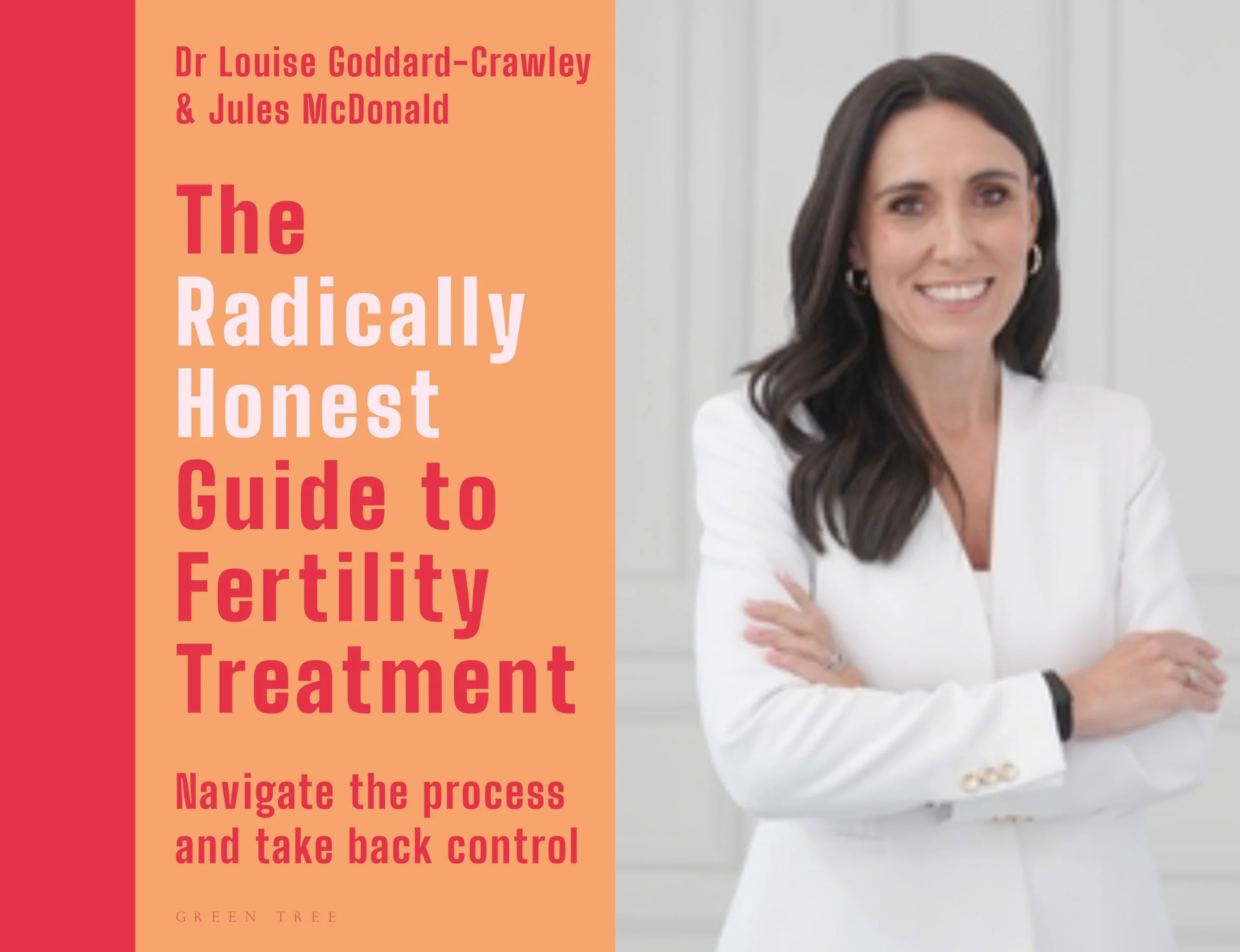
Images: Left: The Radically Honest Guide to Fertility Treatment. Right: Co-author by Jules McDonald
The Radically Honest Guide to Fertility Treatment by Dr Louise Goddard-Crawley and Jules McDonald is published by Bloomsbury.
Bloomsbury is kindly offering LCRH Patients a 20% discount on The Radically Honest Guide to Fertility Treatment by Dr Louise Goddard-Crawley and Jules McDonald between now and October 31st, 2026 when purchased via their website bloomsbury.com with the exclusive code: LCRH20
Follow Dr Goddard-Crawley on Instagram at @drlouisegc